
A driveway in India faces heavy monsoon rain, strong summer sun and daily car traffic. For decades, paver blocks have been the default choice. Today, Stonecrete, a cast-in-situ decorative concrete finish, is a popular alternative for villas, farmhouses and housing projects. This guide compares both options on the points that decide how long a driveway stays strong, safe and good-looking.
Stonecrete vs Paver Blocks: Quick Comparison
| Factor | Paver Blocks | Stonecrete |
| How it is made | Precast blocks laid on a sand bed | Poured and finished on site as one surface |
| Look | Repeating block pattern | Natural stone texture, custom colours |
| Joints | Thousands of joints filled with sand | No block-to-block gaps |
| Weeds | Common in the joints | No joints for weeds to grow in |
| Sinking and loose blocks | Possible when sand washes out or the base settles | No individual blocks to sink or shift |
| Monsoon grip | Depends on the block finish | Textured, anti-skid surface |
| Upfront cost | Lower (about ₹35 to ₹100 per sq ft laid) | Higher, priced per project |
| Repairs | Easy to lift and reset blocks | Needs a trained applicator |
| Upkeep | Regular weeding and joint sand top-ups | Cleaning and periodic sealing |
What Are Paver Blocks?
Paver blocks are precast concrete units in shapes such as zig-zag, I-shape, square and hexagon. They are laid on a compacted base and a layer of bedding sand. The gaps between them are then filled with jointing sand. The interlocking pattern spreads the weight of vehicles across many blocks.
In India, paver blocks are covered by IS 15658:2021, the Bureau of Indian Standards specification for concrete paving blocks. Blocks come in thicknesses such as 60 mm, 80 mm and 100 mm, and in strength grades from M30 to M50. Thicker and stronger blocks are used where heavier vehicles move.
What Is Stonecrete?
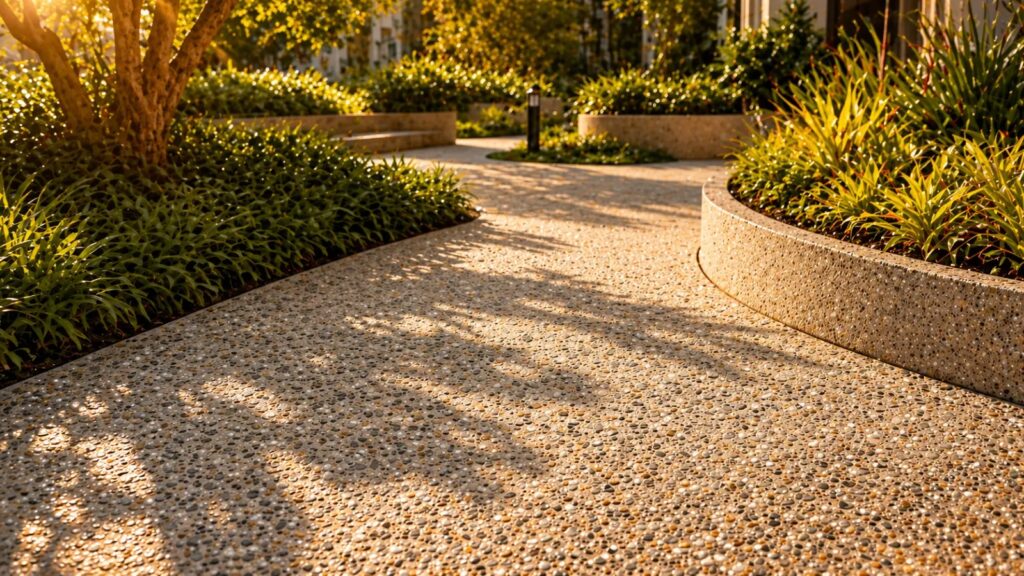
Stonecrete is a decorative concrete finish from Artcrete India (ACI). It is cast in situ, which means it is laid and finished directly on site. The result is one continuous surface with the textured look of natural stone aggregate. The surface is anti-skid, weather resistant and built to take daily car traffic. It is available in different textures and colours to match the design of a home or project.
How Paver Blocks and Stonecrete Are Installed
The installation method explains most of the difference in how each driveway behaves after a few monsoons. Paver blocks are a flexible system held in place by sand and edges. Stonecrete is a rigid system that works as one connected surface.
Paver Block Installation: Step by Step
- Excavation: the soil is dug out to the required depth for the base and blocks.
- Subgrade compaction: the natural soil is levelled and compacted with a roller or plate compactor.
- Sub-base: a layer of crushed stone (or lean concrete for heavy loads) is laid and compacted.
- Edge restraints: kerb stones or concrete edges are fixed along the sides to stop blocks from spreading.
- Bedding sand: a thin, even layer of sand is screeded over the sub-base.
- Laying the blocks: blocks are placed by hand in the chosen pattern, with cut pieces at the edges.
- Compaction: a plate vibrator presses the blocks into the bedding sand.
- Joint filling: fine sand is swept into the joints and the surface is compacted again to lock the blocks.
Paver laying in India is covered by IS 16777:2019, the BIS code of practice for laying paver blocks. A driveway can often take cars soon after laying, because there is no curing time. However, the joints keep settling for the first few weeks, so the sand usually needs a top-up.
Stonecrete Installation: Step by Step
- Site study and design: the team checks the soil, load, slope and drainage, and the client selects texture and colour.
- Excavation and compaction: the ground is dug and compacted to form a firm subgrade.
- Sub-base: a compacted base layer is laid to carry vehicle loads.
- Edges and slope: shuttering is fixed to set the shape, curves and the drainage slope.
- Reinforcement: steel or fibre reinforcement is added as per the load design.
- Casting: the concrete is poured and levelled in one continuous operation.
- Finishing: the Stonecrete finish is worked into the surface to expose the stone texture and create grip.
- Curing and sealing: the surface is cured, then sealed to protect it from stains and weather.
Stonecrete needs a curing period before cars can use it, so the driveway is closed for a short time after casting. In return, the finished surface does not settle joint by joint like a paver driveway. The exact steps and timeline depend on the site, and ACI shares them in the project quote.
Head-to-Head: Which Performs Better on an Indian Driveway?
Strength and Car Loads
Both options can carry cars when they are installed correctly. Paver blocks share the load through interlock, but the system is only as strong as its base and edge restraints. If the edges are weak, the blocks spread apart and the joints open up. Stonecrete works as one slab, so the load is spread across the whole surface. In both cases, the base below matters most. A poorly compacted base will fail under any finish.
Weeds, Sinking and Loose Joints
This is the biggest difference between the two. A paver driveway has thousands of joints. Rain washes out the jointing sand, grass and weeds grow in the gaps, and single blocks can sink or rock. This leaves uneven patches and puddles. Many owners need to weed and refill sand every year.
Stonecrete has no block-to-block gaps. There is no jointing sand to wash out and no space for weeds to root between units. This is the main reason a Stonecrete driveway stays neat for longer with less work.
Monsoon Grip and Drainage
The southwest monsoon brings heavy rain to most of India from June to September, as tracked by the India Meteorological Department. A wet driveway needs good grip and fast drainage.
Paver blocks let a small amount of water pass through the joints. However, the joints also collect dirt and moss, which can make the surface slippery. Smooth or glossy pavers carry the highest risk when wet. Stonecrete has a textured, anti-skid surface. It is laid with a planned slope, so rainwater runs off to the drains instead of standing on the surface.
Sun, Heat and Colour
Coloured paver blocks get their colour from pigment in the top layer. Under strong sun and constant tyre movement, this colour can fade and wear unevenly over the years. Stonecrete gets much of its look from natural stone aggregate, so sun and wear change its appearance less. Lighter aggregate shades also help keep the surface cooler underfoot.
Look and Design Freedom
Paver blocks always show a repeating grid. Colours can be mixed, but the block shape stays visible. Stonecrete gives a seamless natural stone finish with custom colours and textures. It also follows smooth curves around gardens, porches and gates without cut blocks at the edges. For architects working on villas, farmhouses or clubhouses, this gives much more design control.
Cost: Upfront vs Over the Years
Paver blocks are the cheaper option on day one. Based on 2026 market rates, a paver driveway typically costs about ₹35 to ₹100 per sq ft including laying, depending on block thickness, finish and city. Base preparation and kerb stones are usually charged extra.
| Paver block thickness | Typical use | Approx. cost per sq ft (laid, 2026) |
| 60 mm | Footpaths, home driveways with cars | ₹35 to ₹65 |
| 80 mm | SUVs, delivery vans, society roads | ₹45 to ₹85 |
| 100 mm | Trucks, industrial yards, heavy traffic | ₹55 to ₹100 |
| Extra items | Kerb stones, sub-base, excavation | Charged separately |
These are indicative market ranges. The final rate changes with city, block brand, finish, area size and site access.
Stonecrete costs more upfront and is priced per project, based on area, design and site conditions. Over the years, the gap becomes smaller, because a Stonecrete driveway needs no weeding, no sand top-ups and no resetting of sunk blocks.
A fair cost comparison looks at the total spend over the life of the driveway: the installation cost, plus the yearly cost of labour for weeding, sand refilling and resetting blocks, plus any damage from water pooling. For a large villa or housing society driveway, these yearly costs add up and narrow the upfront gap.
Repairs
Here, paver blocks have a clear advantage. A damaged or sunk area can be lifted and relaid using the same blocks. This is useful when pipes or cables run below the driveway. Stonecrete repairs need a trained applicator to match the texture and colour. It is best suited to driveways where the services below are already planned and fixed.
Maintenance Compared: What Each Driveway Needs Every Year
Maintenance is where owners feel the real difference between the two finishes. The table below shows the routine work each driveway needs to stay safe and neat in Indian conditions.
| Maintenance task | Paver Blocks | Stonecrete |
| Sweeping | Weekly | Weekly |
| Washing | As needed; avoid blasting the joints | As needed with a hose or low-pressure washer |
| Weeding | Every few months, more after the monsoon | Not needed |
| Joint sand top-up | After every monsoon, or once a year | Not needed |
| Resetting sunk or loose blocks | As needed, usually near edges and drains | Not needed |
| Moss and algae removal | Common in shaded joints | Occasional cleaning in shaded areas |
| Sealing | Optional, to slow fading and weeds | Periodic re-sealing as advised by the applicator |
| Oil stain cleaning | Needed; stains soak into the blocks | Needed; sealer slows absorption |
Monsoon checklist for both finishes: clear the drains before June, remove leaves and silt from the surface, and check for standing water after the first heavy rain. Standing water points to a slope or drainage problem that should be fixed early.
When Paver Blocks Are the Better Choice
- The budget is tight and the upfront cost matters most.
- Underground pipes or cables may need to be reached often.
- The area is temporary or may be redesigned within a few years.
- The space is a utility zone, such as a service road or rear yard, where looks matter less.
When Stonecrete Is the Better Choice
- The owner wants a driveway that stays neat without regular weeding or resetting.
- The project is a villa, farmhouse, clubhouse or premium housing society where looks matter.
- The driveway gets heavy rain and needs an anti-skid surface.
- The design includes curves, borders or custom colours.
- The driveway connects to garden paths, porches or pool decks that need one matching finish.
For matching outdoor finishes, ACI also offers Stamped Concrete for patterned surfaces and Sandcrete for fine textured surfaces. Readers who prefer a pebble look can read ACI’s guide to pebble flooring for outdoor spaces.
Checklist Before Choosing a Driveway Finish
- Check the vehicle load: cars only, or also SUVs, delivery vans or fire tenders.
- Check the base: soil type, compaction and the slope needed for drainage.
- Plan services first: lay pipes and cables before the final finish goes down.
- See real projects: visit completed work, not only samples. ACI’s project portfolio shows outdoor work across India.
- Compare lifetime cost: look at maintenance over the years, not only the day-one rate.
- Confirm upkeep: decide who will clean, weed or seal the surface, and how often.
Frequently Asked Questions
Which is cheaper, Stonecrete or paver blocks?
Paver blocks are cheaper upfront, at about ₹35 to ₹100 per sq ft including laying in 2026. Stonecrete costs more at the start but needs less maintenance over the years.
Do paver blocks sink over time?
Yes, they can. Paver blocks sink when the base is poorly compacted, when rain washes out the bedding or jointing sand, or when the edge restraints fail.
Is Stonecrete strong enough for cars?
Yes. Stonecrete is engineered for daily car traffic on residential and commercial driveways when it is laid on a properly prepared base.
Is Stonecrete slippery in the monsoon?
No. Stonecrete has a textured, anti-skid surface that gives grip on wet days. This is why it is also used for pool decks, walkways and ramps.
What thickness of paver block is best for a home driveway?
For a home driveway used by cars, 60 mm paver blocks are the common choice. For SUVs, delivery vans or frequent heavy vehicles, 80 mm blocks are safer. 100 mm blocks are used for very heavy loads such as trucks and industrial yards.
Is Stonecrete the same as stamped concrete?
No. Stamped concrete gets its pattern from moulds pressed into wet concrete, such as brick, slate or wood designs. Stonecrete shows the texture of real stone aggregate on the surface. Both are cast in situ, but the final look is different.
Can Stonecrete be used for pathways and pool decks as well?
Yes. Stonecrete is used for garden pathways, courtyards, pool decks, walkways and plazas. This lets the driveway and the surrounding outdoor areas share one matching, anti-skid finish.
Which lasts longer in India, Stonecrete or paver blocks?
With correct installation, Stonecrete usually stays in good condition longer with less upkeep, because it has no joints for weeds, sand loss or sinking. Paver blocks also last well, but need regular weeding, sand refilling and resetting.
Sources
- Bureau of Indian Standards, IS 15658:2021 Concrete Paving Blocks, Specification
- Bureau of Indian Standards, IS 16777:2019 Laying of Paver Blocks, Code of Practice
- India Meteorological Department, Monsoon Information
- Paver block cost ranges: Indian market rates, 2026 (indicative)
Plan a Stonecrete Driveway with ACI
Artcrete India has delivered 500+ projects across India, with work at landmarks such as Reliance Vantara, Ram Mandir and the Statue of Unity. Architects, builders and villa owners can share the driveway size and site details to get a project-specific quote.